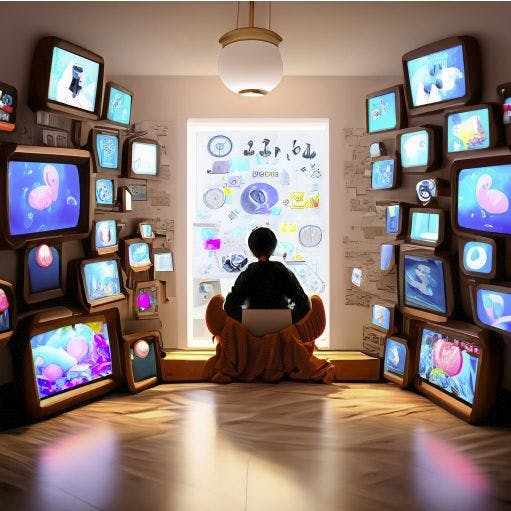
Once upon a time in our digital Odyssey, we believed that personalization would be our North Star, guiding us to a more intuitive, more bespoke internet. Yet as we chase this, we find ourselves not under an open sky but entangled in a labyrinth of mirrors, reflecting nothing but ourselves.
The seductive call of personalization is hard to ignore. Who wouldn’t want their digital universe tailored to their tastes and preferences, a world where algorithms act as personal butlers, predicting needs, and serving up desired content on a silver platter? However, this convenience comes at a price – isolation, sensitivity to the unfamiliar, and a growing trend towards self-centeredness.
Imagine sitting in a room filled with mirrors, each one reflecting only your image. This room is cozy, comfortable, and custom-made. But as days turn into nights, the reflections start feeling repetitive, the room begins to shrink, and you realize – you are utterly alone.
This is the paradox of personalization.
Our digital rooms, curated by algorithms, echo our thoughts, amplify our voices, and paint our walls with colors we like. Yet, in the process, they mute the noise of diverse perspectives, dim the vibrancy of shared experiences, and reduce the panorama of human existence to a myopic self-portrait.
A room filled with screens personalized for one person.
Basking in the solace of our digital echo chambers, we become increasingly sensitive to anything outside of them.
As our patience for diverse opinions dwindles, so does our capacity for empathy and understanding. The world outside our personalized rooms starts to feel abrasive, confrontational, even threatening. The trend doesn’t stop there, as the digital spotlight shines solely on us, ego bloats to fill the stage.
Concerns for others retreat into the shadows, and a subconscious focus on “I” takes center stage. With our digital assistants fawning over our every whim and need, could we be breeding a generation more narcissistic than altruistic?
Amidst these concerns, a question arises: could the personalized paradise we’ve been promised be nothing more than an illusion? As we navigate this potential mirage, the comfort of our individual reflections begins to clash with a deep-seated yearning for genuine, rooted connections. Could we consider a shift from personalization to personal growth? As we examine our algorithms, are they serving merely as echo chambers or could they act as windows to the world? Should we demand they help us venture beyond our comfort zones, challenging us to grapple with novel perspectives, unfamiliar cultures, and the rich spectrum of human emotions?
Digital waypoints. Who put them here? Where do they lead us?
As we fine-tune our digital compasses, what is the balance we seek? Is it a state of equilibrium between convenience and curiosity, between introspection and empathy, between the solitary echo of “I” and the harmonious symphony of “Us”? If the beauty of human existence lies in shared experiences, in the diverse palette of opinions, and the combined melody of myriad voices, are we losing sight of it within our personalized confines?
When we stare into our digital mirrors, is our solitary reflection enough?
Or should we strive to see the world in all its glory, color, and complexity mirrored back at us? Perhaps the true power of technology isn’t to ensnare us in individualistic mirrored rooms, but to unite us within a shared digital agora, a space that celebrates and fosters our collective identity.
This article was originally published by Micheal on Hackernoon.
DARPA's O-Circuit program looks to build a new class of biologically inspired computer equipped with…
As AI races into classrooms worldwide, Google is finding that the toughest lessons on how…
The push to eat bugs is not an organic movement coming from the people, but…
As Africa’s digital economy accelerates, a new partnership between the Africa Digital Assets Summit 2026…
The State of Generative AI in the Enterprise report from Menlo Ventures found that companies…
Living therapies, made of engineered immune cells – and capable of hunting down cancer, reversing…